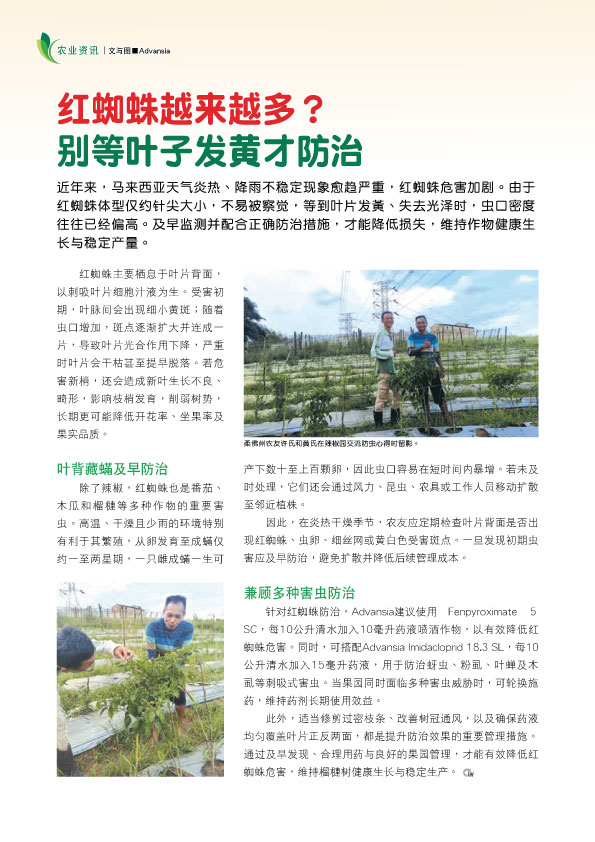
In recent years, Malaysia has experienced hotter weather and increasingly unstable rainfall patterns, causing red spider mite problems to become more serious. As red spider mites are only about the size of a needle tip, they are not easily noticed. By the time leaves turn yellow and lose their shine, the pest population is often already high. Early monitoring, together with proper control measures, is key to reducing losses while maintaining healthy crop growth and stable yield.
Red spider mites mainly live on the underside of leaves, feeding by sucking the cell sap from leaf tissue. In the early stage of damage, tiny yellow spots may appear between the leaf veins. As the pest population increases, these spots gradually expand and join together, causing the leaf’s photosynthesis ability to decline. In serious cases, leaves may dry up and fall off prematurely.
If the damage continues, it may also cause poor and uneven new leaf growth, affect shoot development, weaken tree vigour, and over the long term, reduce flowering rate, fruit-setting rate, and fruit quality.
Hidden Under Leaves, Early Control Is Important
Besides chilli, red spider mites are also important pests in crops such as tomato, papaya, and durian. Hot, dry, and low-rainfall conditions are especially favourable for their reproduction. From egg to adult mite, they may complete development in only one to two weeks. One female adult mite can lay dozens to more than a hundred eggs in her lifetime, allowing the population to increase rapidly within a short period.
If not controlled in time, red spider mites can also spread to nearby plants through wind, insects, farm tools, or the movement of workers.
Therefore, during hot and dry seasons, farmers should regularly inspect the underside of leaves for red spider mites, eggs, fine webbing, or yellow damage spots. Once early signs are found, control should be carried out immediately to prevent the pest population from increasing and to reduce later management costs.
Managing Multiple Pests Together
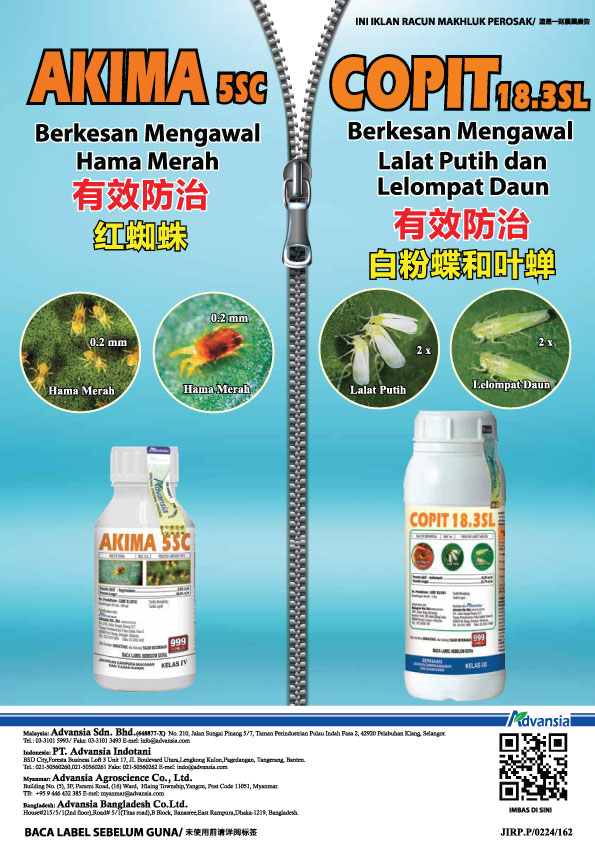
For red spider mite control, Advansia recommends using Fenpyroximate 5SC at 10ml mixed with 10 litres of clean water and sprayed evenly on crops to effectively reduce red spider mite damage.
At the same time, Advansia Imidacloprid 18.3SL can be used at 15ml mixed with 10 litres of clean water to control sucking pests such as aphids, whiteflies, leafhoppers, and other similar pests. When orchards face pressure from several pest types at the same time, farmers may rotate products to maintain long-term control effectiveness.
In addition, proper pruning of overly dense branches, improving canopy ventilation, and ensuring the spray solution evenly covers both the upper and lower leaf surfaces are important management practices to improve control results.
Through early detection, proper pesticide use, and good orchard management, farmers can effectively reduce red spider mite damage while maintaining healthy plant growth and stable production.
At Advansia, we continue to focus on practical, field-tested solutions that match the real conditions faced by Malaysian growers. Whether the need is better flower retention, stronger fruit development, or more reliable disease control, timely action and suitable crop strategies remain key to achieving more stable results in the field.
📌 Explore more solutions or contact our team for customized advice at www.advansia.com