


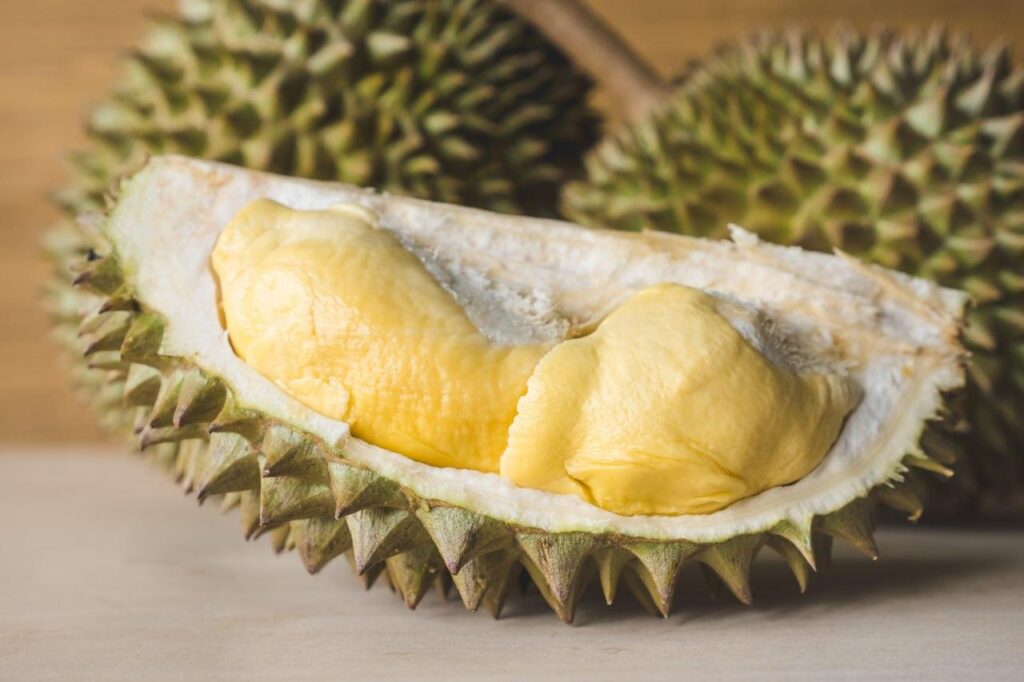
A common misconception among farmers is that low durian yields are solely due to fertilizer issues. However, this is not the case. Even with high-quality fertiliser, a durian tree will not produce well if it lacks adequate water, proper pollination, or a healthy growing environment. To improve durian production, it is crucial to consider all factors affecting the tree: water, flowers, nutrients, and soil, rather than focusing on just one aspect.
Read on to learn how to identify common problems and fix them for better yields.
Nutrient Deficiency Symptoms
Before managing water, fertiliser, or canopy, farmers should first observe the existing conditions of the tree. Nutrient problems in durian are often diagnosed through visible signs on the leaves, flowers, and fruit, as different nutrient deficiencies display specific symptoms.
- Nitrogen deficiency: older leaves turn yellow, slow overall growth
- Potassium deficiency: small fruits, poor sweetness, uneven ripening
- Calcium deficiency: weak fruit structure, fruit drop, tip damage
- Magnesium deficiency: yellowing between leaf veins while the veins stay green
- Boron deficiency: poor flowering, flower drop, low fruit set
Accurate identification is crucial since many yield issues are misdiagnosed and treated with inappropriate fertilizers.
Water Management
Research consistently shows that water availability is the most important factor in yield stability and fruit quality, as even well-fertilised trees will not produce fruit properly when under water stress. Different growth stages require varying water levels, as flower initiation, flowering, fruit set, and fruit enlargement have different sensitivities.
Durian trees require the right amount of water at specific times, particularly during flowering and fruiting. If they don’t receive enough water, they may drop flowers, produce fewer fruits, and yield smaller or lower-quality durians. Conversely, if they receive too much water, such as during flooding, their roots can suffocate, leading to failures in growth.
Durian requires more than just water; it benefits from controlled stress cycles, as slight dryness can sometimes initiate flowering in certain orchards.
Tips: Ensure proper drainage to avoid waterlogging, irrigate during dry spells, and maintain consistent moisture levels throughout flowering and fruit development.
Pollination & Fruit Set Efficiency
Durian typically experiences low fruit set due to poor pollination, causing major yield loss before fruit even forms. You may wonder why durian trees produce so many flowers, yet most of them don’t develop into fruit.
Pollination in durian involves more than just the presence of insects or bats. It also depends on factors like timing (especially night activity), humidity levels, the release of floral scent, and synchronisation between compatible flowers. Durian flowers only open for a short period, usually at night.
If insects or bats fail to pollinate effectively during this narrow window, many flowers fall off without forming fruit. Low yield is often caused by a combination of poor pollen viability and mismatched flower timing, not simply a lack of pollinators.
Tips: Encourage natural pollinators such as bats and insects, depending on the region, avoid pesticide spraying during the flowering period, and consider using hand or assisted pollination in commercial orchards.
Nutrient Management
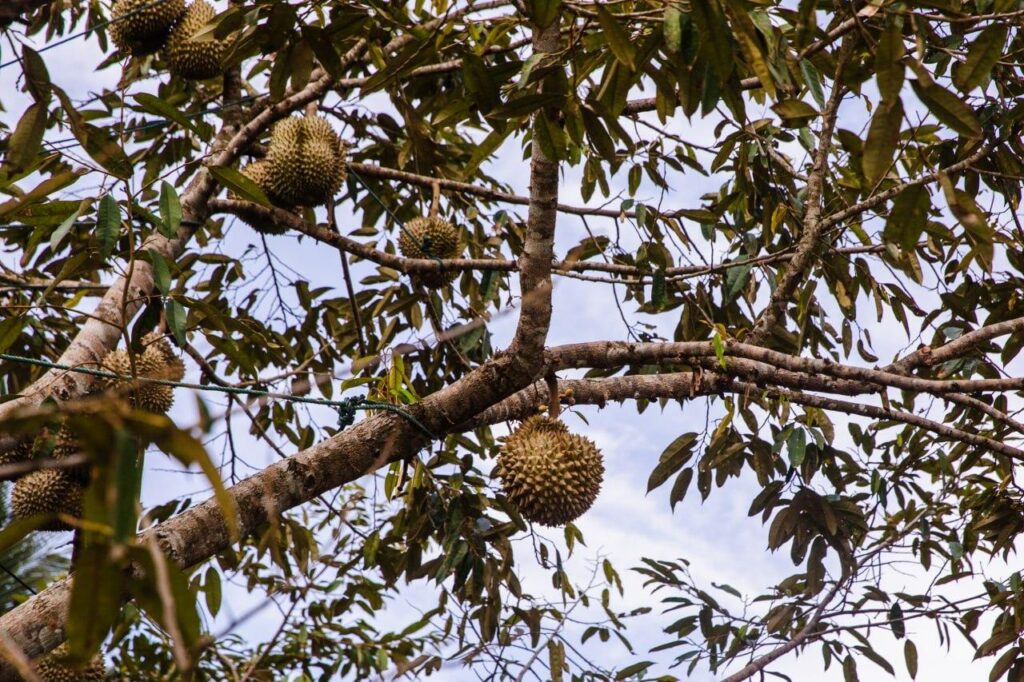
Recent research shows that yield improvements depend more on balanced fertilisation than on high fertiliser rates, as nutrients significantly influence fruit size, retention, and quality, especially after a successful fruit set. Nutrients affect not just fruit size, but also flower fertility, pollen tube growth, and fruit retention hormones.
If nutrients are not balanced, fruits may drop prematurely, be smaller in size, and the tree may produce excessive vegetative growth (too many leaves instead of fruit). Excess nitrogen (N) not only leads to this imbalance; it can also actively suppress flowering in some cases.
Potassium is essential for developing large, sweet fruits, while calcium helps prevent early fruit drop and reduces physiological disorders. The canopy also plays an important role in airflow, as it directly influences the formation of flower bud sites.
Tips: Apply NPK fertilizers and organic fertilizers in multiple applications rather than all at once; increase potassium levels during the flowering and fruiting stages, apply calcium to reduce fruit drop and related disorders, and incorporate organic matter to improve soil structure.
Canopy Management
Improving canopy structure enhances both flowering and fruit development by increasing the efficiency of the previously mentioned factors.
Pruning enhances airflow, light penetration, and nutrient distribution within the tree. A poorly managed canopy can lead to excessive vegetative growth and reduced yield potential.
Tips: After harvesting, remove dead or crowded branches, maintain an open canopy structure, and avoid heavy pruning during the flowering period.
Site & Soil Conditions
Research indicates a strong interaction among topography, soil moisture, and root development, which establishes the orchard’s baseline potential.
Poor drainage negatively impacts root health and yields stability. In contrast, well-drained slopes or properly structured soils enhance root development and overall productivity. Site selection, therefore, involves more than simply avoiding flooding, as it also influences long-term root architecture and yield potential.
Nutrient availability also varies with pH levels. For example, phosphorus can become locked up in acidic soils, reducing its accessibility to the plant even when present in the soil.
Tips: Avoid soils that are prone to flooding. When necessary, use raised beds or terracing, and maintain adequate soil organic matter while ensuring proper pH levels.
Pest & Disease Management
Pest and disease control matters, but it doesn’t usually increase the number of durians produced. Instead, it mainly prevents losses of fruits that would have developed under healthy conditions.
Good pest control doesn’t directly create more fruit; rather, it prevents damage such as from being eaten, flowers from failing, and young fruits from dropping or rotting before maturity.
Disease pressure is often linked to environmental and management factors such as poor canopy health, high humidity, and nutrient imbalances, not just pests.
Tips: Implement integrated pest management (IPM) by using “Advansia Integrated Durian Solutions” to use the correct agrochemicals during flowering and regularly monitor the fruit development stages.
Key Takeaway
Achieving a high yield of durian is all about addressing the right problems at the right time. Lack of water can lead to poor flowering and fruit drop, insufficient pollination results in no fruit, and an imbalance in nutrients can produce small or low-quality durians. To improve yields, avoid guessing. Instead, observe the tree, identify the limiting factor, and address that issue first.
References
- Bumrungsri, S., Sripaoraya, E., Chongsiri, T., Sridith, K., & Racey, P. A. (2009). The pollination ecology of durian (Durio zibethinus L.) in southern Thailand. Journal of Tropical Ecology, 25(1), 85–92. https://www.cambridge.org/core/journals/journal-of-tropical-ecology/article/abs/pollination-ecology-of-durian-durio-zibethinus-bombacaceae-in-southern-thailand/
- Brown, M. J. (1997). Durio: A bibliographic review. International Plant Genetic Resources Institute (IPGRI). https://link.springer.com/article/10.1186/s40851-024-00228-x
- Department of Agriculture Malaysia. Pakej Teknologi Durian. https://www.doa.gov.my/doa/modules_resources/bookshelf/pt_buah_durian_2012/pt_durian_2012.pdf
- Lim, T. K. (2020). The Durian. In Horticultural Reviews (Vol. 47). Wiley. https://onlinelibrary.wiley.com/doi/10.1002/9781119625407.ch4
- Stewart, A. B., et al. (2024). Bat pollinators: A decade of monitoring reveals declining visitation rates for some species in Thailand. Zoological Letters, 10, 1–16. https://link.springer.com/article/10.1186/s40851-024-00228-x
- Marschner, P. (2012). Marschner’s Mineral Nutrition of Higher Plants (3rd ed.). Academic Press. https://www.sciencedirect.com/book/edited-volume/9780123849052/marschners-mineral-nutrition-of-higher-plants?via=ihub%3D

