


Little did we know that durian, the king of fruits in Southeast Asia, is projected to exceed $8 billion by 2026, driven by rising global demand and tech-driven farming.
Some might think that durian has a love-hate relationship with the global market because of its pungent smell, unlike in producer countries such as Malaysia, Thailand, and Indonesia, but its sweet flesh can win hearts.
Heavy rains in October and November, followed by reduced rainfall in December 2025, indicated that the El Niño climate pattern has caused the weather to be drier than usual in Southeast Asia.
Starting in January 2026, this dry spell acts as a natural alarm clock for durians to begin flowering. With rainfall patterns differing from previous years, 2026 promises a stronger year for flowering due to the prolonged drought.
This could only mean one thing: a stronger flowering season and a more intense harvest.
What Is Durian Flowering?
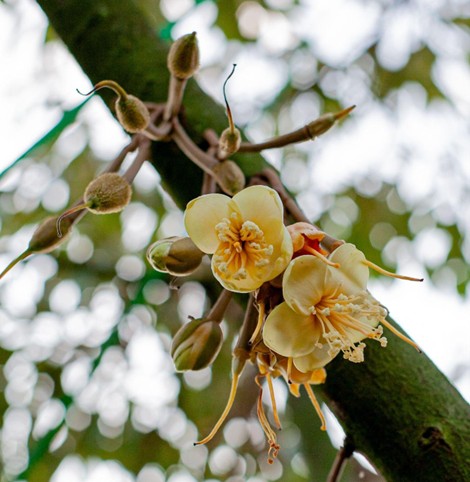
Durian trees flower in response to dry periods. In many tropical climates, these dry spells occur once or twice a year, but flowering can happen whenever the right conditions are met.
Each flowering cycle lasts about two months, from bud emergence to full bloom. Durian flowers are nocturnal, typically opening in the early afternoon or evening and ready for pollination overnight. This pollination window is very brief, lasting only about 18–20 hours.
Durian flowers are pollinated mainly by nectar-feeding bats, especially the cave nectar bat, and by moths. Farmers often help with hand pollination to improve fruit set. Cross-pollination generally produces better yields than self-pollination.
Despite producing many flowers, only a few develop into fruits. The surviving fruits take about 3 to 4 months to grow and ripen. However, the final yield depends on successful pollination, weather conditions—particularly rain, which can hinder pollination—and orchard care, such as fertilization, pruning, and pest management.
Dry Spell as the Main Flowering Trigger
Earlier research suggested that temperature triggered durian flowering. However, recent studies show that temperature alone is not the trigger. Instead, it is dry conditions — periods of little or no rain — that make the trees flower.
The trees can sense a long dry spell, and this water stress sends a signal to start producing flowers. After the dry period, when the rain returns, the flowers can grow into fruits because water is now available.
During the Northeast Monsoon, which typically occurs in January and February, the weather is often dry, hot, and windy, locally referred to as “musim timur.” Throughout this period, some areas may experience prolonged dry spells without rain, which is ideal for durian trees as they produce flowers. Later, when the rains return around April, these flowers develop into fruits.
A study found that a short, mild drought lasting about 15 days, with less than 1 millimeter of rain, actually helps durian trees begin to grow flower buds.
Durian Flowering Forecast 2026
Northern & Western Malaysia (Perlis, Kedah, Penang, northern Perak)
- Main flowering: January–March (main dry season)
- Possible secondary flowering: July–August (short mid-year dry spell)
- Training programs on best orchard practices, pest management, and export compliance.
Central & Southern Malaysia (southern Perak, Selangor, Negeri Sembilan, Melaka, Pahang, Johor)
- Dry periods: January–February and July–August
- Flowering windows: February–April and July–September
- Corresponds to two peaks in Malaysian durian production
East Coast Malaysia (Kelantan, Terengganu, coastal Pahang to Johor)
- Main flowering: March–June (triggered by dry spell)
- Later fruiting: July–September
East Malaysia (Sabah & Sarawak)
- Main flowering peak: March–April
- Some localized flushes (especially in Sabah): August–September (smaller than main season)
How Farmers Can Prepare for 2026
Preparation Tips for Durian Growers
Pre-flowering fertilization
- Use Soil Tests to Guide Fertilizer
Before applying fertilizer to your durian trees, check the existing nutrient levels in your soil, particularly nitrogen (N), phosphorus (P), and potassium (K), which are essential for growth. Test your soil before flowering and at key growth stages. Apply fertilizer based on the actual needs of your soil, rather than out of habit, to avoid giving either too little or too much.
- Fertilize with Precision
Don’t just sprinkle fertilizer everywhere; instead, give exactly what each tree needs at the right time. Apply nutrients in the right balance (N, P, K) without treating the whole orchard the same if trees have different needs. Spread applications over time rather than all at once for better tree growth and less environmental harm.
- Connect Fertilizer to Your Yield Goals
Fertilizer should be part of your plan to achieve a specific fruit yield, not just a routine task. Early on, decide how much fruit you want to harvest and adjust fertilizer to help reach that target. This makes your fertilization smarter and your results more predictable.
Irrigation planning
Despite dry spells triggering flowering, durian trees actually need sufficient water while flowering and developing fruit. Without enough water, yields drop and fruit quality suffers. But too much water (over‑irrigation) can cause root rot, a serious fungal disease that damages durian trees, and too little water (drought stress) weakens the trees, making them more vulnerable to insect pests.
With climate change, rainfall has become unpredictable. A hybrid solar irrigation system can help to power pumps that draw water from underground. If there isn’t enough sun, the system can switch to the normal electricity grid as a backup. This setup makes the water supply more reliable, cuts energy costs by almost half, and reduces pollution compared to diesel or full-grid systems.
Pest control
Durian trees get attacked by fruit borers that tunnel into the fruit, making it rot or fall off early; mealybugs and scale insects that weaken the tree and leave sticky stuff that grows black mold; shoot and leaf borers that chew into young shoots and leaves, slowing growth; and root and trunk borers that attack the woody parts of the tree, sometimes killing it.
Farmers can fight them by not just spraying chemicals all the time. Instead, use a mix of methods — keep the orchard clean, use natural predators, and only spray when necessary. This approach is called Integrated Pest Management (IPM), and it’s safer, cheaper, and better for the environment.
Monitoring buds
Buds are the first sign of flowering. If you catch them early, you can predict when fruit will come. Buds are also the stage when trees are most sensitive to pests, diseases, and water stress, which can easily damage them. Monitoring helps farmers time irrigation, pest control, and fertilizer so the tree has enough strength to carry fruit.
Key Takeaway
Driven by prolonged dry spells, durian flowering in Malaysia is expected to be strong in 2026. With proper preparation, including soil testing, fertilization, and pest management, growers can look forward to a fruitful harvest. Advansia provides expert guidance and solutions to help maximize yield and quality. Contact us to plan your orchard today.
References
- Anunthawichak, S. I., Akkaratatta, C., & Kiettikunwong, N. (2026). Creating sustainable water management in durian cultivation in Thailand with hybrid solar irrigation. Discover Sustainability, 7, 100. https://doi.org/10.1007/s43621-025-02388-y
- Baqi, A., Lim, V. C., Yazid, H., Anwarali Khan, F. A., Lian, C. J., Nelson, B. R., & Kumaran, J. V. (2022). A review of durian plant–bat pollinator interactions. Journal of Plant Interactions, 17(1), 105–126. https://doi.org/10.1080/17429145.2021.2015466
- Eguchi, A., Hassan, N., & Numata, S. (2025). Dry spells trigger durian flowering in aseasonal tropics. International Journal of Biometeorology, 69(2), 403–409. https://doi.org/10.1007/s00484-024-02819-x
- Salakpetch, S. (2001). Durian (Durio zibethinus L.) flowering, fruit set and pruning. Chanthaburi Horticultural Research Center.
- Tang, R., Wei, S., Tang, J., Aridas, N., & Talip, M. (2024). A method for durian precise fertilization based on improved radial basis neural network algorithm. Frontiers in Plant Science, 15, Article 1387977. https://doi.org/10.3389/fpls.2024.1387977

